

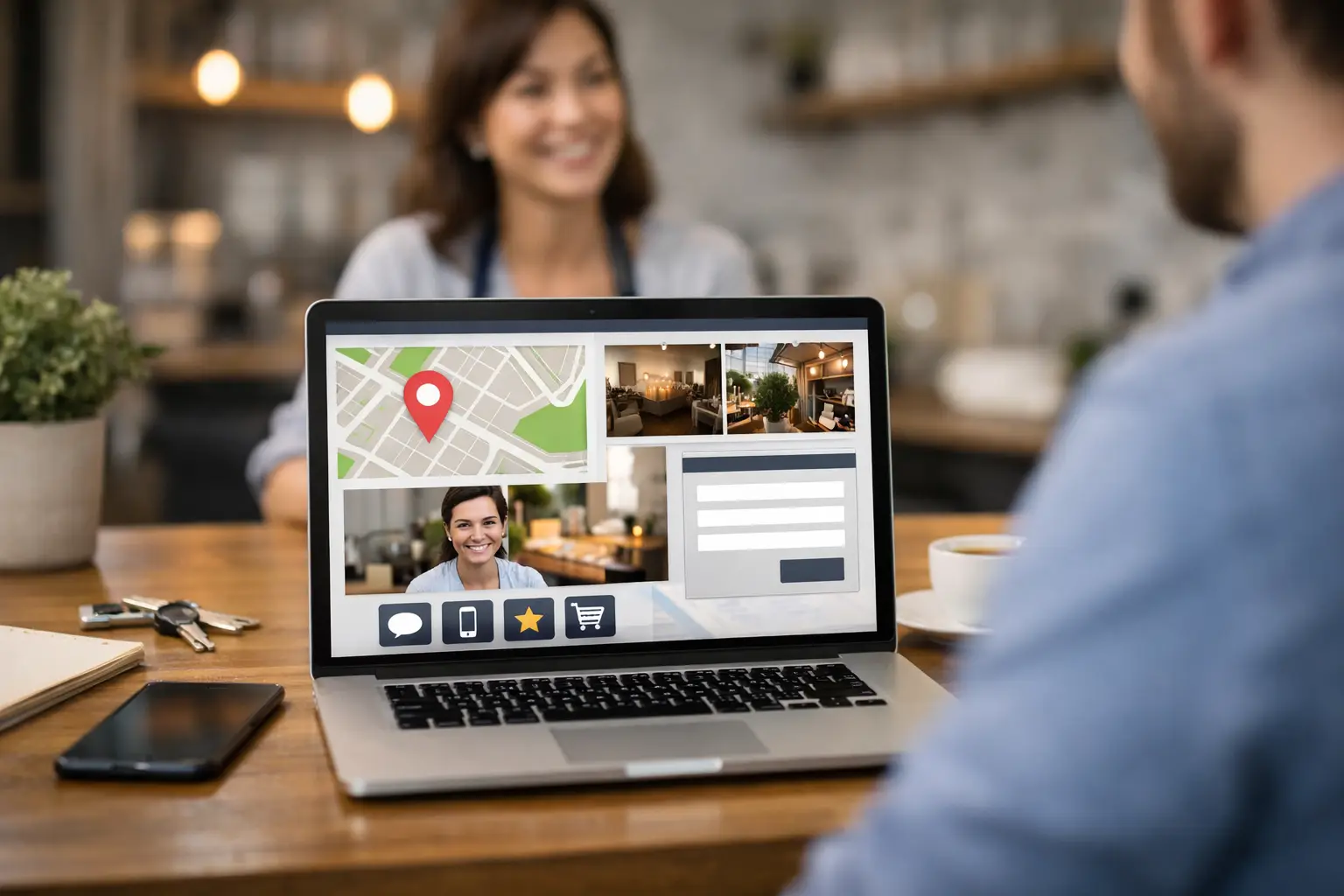

A local customer who needs a plumber, solicitor, café or electrician rarely spends long comparing websites. They want to know whether you cover their area, whether you look credible, what the service involves and how to get in touch. The best local business website features make those answers quick to find, helping turn a Google search into a genuine enquiry rather than a lost opportunity.
For businesses across Lanarkshire, Glasgow and the wider area, a website should do more than look polished. It should support your visibility in local search, strengthen confidence in your business and give visitors a clear reason to contact you. Here are the features that make the biggest commercial difference.
1. A clear message above the fold
The top section of every key page should say exactly what you do, who you help and where you work. A visitor should not have to scroll through large images or vague marketing language before finding the basics.
A strong opening might state your core service, your main service area and a practical benefit, followed by a prominent call to action. For example: “Reliable heating repairs across Hamilton and South Lanarkshire. Call today to arrange a visit.” It is simple, direct and useful.
This is especially important on mobile, where customers may be searching while dealing with an urgent issue. Make the next step obvious: call, request a quote, book an appointment or send an enquiry.
2. Mobile-first design that is easy to use
Most local searches happen on a phone. If your site is awkward on a small screen, slow to load or difficult to navigate with a thumb, potential customers will leave before they understand what you offer.
Mobile-first design means more than shrinking a desktop layout. Phone numbers should be tappable, forms should be short, text should be readable and buttons should be easy to press. Your most important information – services, locations, reviews and contact details – needs to appear without unnecessary hunting.
A highly visual site can look impressive but still perform poorly if oversized images delay loading. The right balance is a professional design that remains fast, focused and straightforward to use.
3. Prominent contact options
A local business website should never make people search for a phone number. Display it clearly in the header and footer, and include a visible contact button throughout the site. For service businesses, a click-to-call option is essential.
Different customers prefer different routes. Some want to call immediately, while others would rather complete a form outside normal hours. A good website provides both, with a concise enquiry form that asks only for the information needed to respond properly.
If you use WhatsApp, online booking or a callback request, these can be useful additions. They should support your main contact route rather than distract visitors with too many competing choices.
4. Service pages built for real searches
One generic page listing every service is rarely enough to perform well in Google or explain your value properly. Each important service deserves its own focused page, written around the questions customers actually ask.
A roofing company, for instance, may need separate pages for roof repairs, flat roofing, guttering and emergency call-outs. A professional practice might require individual pages for conveyancing, wills, family law or accountancy services. This gives each service a clearer chance to appear for relevant searches.
Each page should explain the work, the types of customer you help, what the process looks like and how to request a quote or consultation. Avoid creating thin pages that merely swap one service name for another. Useful detail builds trust as well as search visibility.
5. Location information with genuine local value
Customers want reassurance that you serve their town or neighbourhood. Search engines also need clear signals about where your business operates. Include your address where relevant, your service area and consistent contact details across the website.
For businesses serving several locations, dedicated area pages can work well when they provide genuine information. That may include common services in that area, local availability, directions to your premises or relevant completed projects. Copying the same paragraph and changing “Lanark” to “Motherwell” offers little value to visitors and can weaken quality.
A local map can be helpful for shops, clinics, restaurants and offices where customers visit in person. Mobile visitors should also be able to get directions quickly.
6. Reviews and proof that people can verify
Good design earns attention. Proof earns enquiries. Include recent customer reviews on key pages, especially your homepage and service pages, alongside clear evidence of the work you do.
For trades and practical services, before-and-after photographs, project summaries and short case studies can be persuasive. For professional services, client testimonials, years of experience, qualifications and industry memberships often carry more weight. Use only genuine reviews and ensure you have permission to publish client feedback.
Google reviews matter because they influence both local visibility and customer confidence. A website should make your reputation visible without relying on exaggerated claims that cannot be supported.
7. Trust signals that answer the unspoken questions
Before making contact, visitors are often asking themselves: Is this business legitimate? Will they turn up? Are they qualified? What happens if something goes wrong?
Your website should answer these concerns naturally. Show your trading address where appropriate, company information, insurance details, accreditations, guarantees, payment options and clear policies. Introduce the people behind the business with real photographs and short profiles rather than generic stock images wherever possible.
The appropriate level of detail depends on your industry. An emergency locksmith needs to establish availability and credentials quickly. A wedding venue needs strong photography, capacity information and viewing options. Trust is not a single badge in the footer – it is the overall impression created by clear, consistent information.
Best Local Business Website Features for Search Visibility
8. Strong on-page local SEO foundations
A well-designed website cannot deliver its full value if potential customers cannot find it. Local SEO begins with clear page titles, relevant headings, accurate business details and copy that reflects the services and places you genuinely cover.
It also relies on the technical basics. Search engines need to crawl your pages easily, understand their purpose and access a secure, fast website. Structured business information, properly organised internal pages and image descriptions all support this work.
Your Google Business Profile should match the details on your website, including your business name, address, phone number and opening hours. Consistency helps avoid confusion for both customers and search engines.
9. Fast loading pages
Website speed affects first impressions, usability and search performance. A visitor seeking an urgent repair or a same-week appointment is unlikely to wait while large video files, animations and uncompressed images load.
Speed improvements often come from practical choices: properly sized images, efficient code, reliable hosting and avoiding unnecessary plug-ins. Do not assume a feature is worthwhile simply because it looks modern. If it adds seconds to the load time without helping customers make a decision, it may be costing you enquiries.
10. Useful frequently asked questions
An FAQ section works best when it handles real objections before a visitor needs to call. It might cover pricing approach, response times, areas served, appointment availability, guarantees or what to expect at the first visit.
For example, a business could explain whether estimates are free, whether there is a call-out charge, how long a typical job takes and whether weekend appointments are available. Straight answers reduce hesitation and improve the quality of incoming enquiries.
Keep FAQs specific to the service page where possible. A question about boiler servicing belongs on the boiler servicing page, not buried in a general list at the bottom of the site.
11. Clear calls to action on every page
Every page should have a purpose. Once a visitor has read about a service, seen your reviews and checked that you cover their location, tell them what to do next.
Use action-led wording such as “Request a free quote”, “Book your consultation” or “Call for same-day availability”. The best choice depends on how your business sells. High-value services may benefit from a consultation request, while urgent local services need a phone call to be the priority.
Avoid generic buttons such as “Learn more” when a more specific action would be clearer. The fewer decisions a visitor has to make, the easier it is for them to take the next step.
12. Measurement and ongoing improvement
A website is not finished when it goes live. You need to know which pages generate calls, forms and quote requests, which services attract search traffic and where visitors leave without contacting you.
Tracking should focus on meaningful outcomes, not vanity figures. A rise in visitors is useful only if those visitors are in your service area and likely to become customers. Reviewing results allows you to improve underperforming pages, add missing information and invest more confidently in SEO, Google Ads or content.
For many SMEs, managing all of this internally is unrealistic. A managed website and marketing approach gives you one accountable partner for the site, local search visibility, paid campaigns and reputation support.
The right features are not about cramming every available tool into your website. They are about removing doubt, making contact easy and giving local customers a clear reason to choose you. If your current site looks fine but produces too few enquiries, a focused review can reveal exactly where it is falling short.